

This performance includes fog, haze, and flashing lights. It contains brief suggestive or sexual content (no nudity).
In Act II, a live snake and trained handler appear on stage.
Music by Jules Massenet • French libretto by Louis Gallet
Based on the novel of the same name by Anatole France
Friday, March 27, 2026 • 7:30 PM
Sunday, March 29, 2026 • 2:30 PM
The Egyptian Theatre
Sung in French with English supertitles.
Run Time: Approximately 3 hours, including a 20-minute intermission after Act I and a short break after Act II.
Tickets also available at the door!
Enhance your experience: Join us at Thaïs’s Operatini, our Pre-Performance Dinner, or Center Stage with Stacey. Click here to learn more!
The Story
Seductive, searching, and emotionally charged, Thaïs is a story of transformation told through longing, conviction, and the dangerous certainty of believing you know what is best for another soul.
Set in ancient Alexandria, the opera centers on Thaïs, a celebrated courtesan whose beauty and charisma have made her both idolized and infamous. Her world is one of admiration and excess—but beneath the surface, cracks are beginning to show. Time, doubt, and the fear of emptiness linger just beyond the glow of the spotlight.
Into this world steps Athanaël, a monk from the desert, fiercely devoted to his faith and haunted by his own past. Convinced that Thaïs represents everything corrupt about the city, he sets out to confront her. What he believes is a mission of salvation quickly becomes something far more personal.
As Thaïs and Athanaël collide, the opera unfolds as a psychological duel. Thaïs begins to question whether admiration can offer meaning or permanence, while Athanaël’s rigid certainty is slowly undermined by emotions he refuses to name. Their choices draw them farther from Alexandria’s glittering streets and into the unforgiving desert stillness, where certainty begins to unravel.
Massenet’s lush and evocative score mirrors this inner struggle at every turn. The orchestra glows with sensual warmth and aching restraint, most famously in the radiant Méditation—a moment of stillness that captures the opera’s emotional core without a single word.
By the final act, Thaïs reveals itself not as a simple tale of sin and redemption, but as a searching examination of desire, power, and the cost of absolute conviction. It is an opera that resists easy answers, inviting the audience to sit with ambiguity and reflect on who is truly changed when one life is reshaped by another.
Bold, intimate, and brought to life on a scale Opera Idaho has never presented before, Thaïs offers an unforgettable evening of music and drama—one that lingers long after the curtain falls.
From the Director
I first heard Thaïs’s aria, “Dis-moi que je suis belle,” when a classmate brought it to class in school, and I was hooked. I loved seeing the rawness of a character who is so cultivated and still so vulnerable, and fell in love with the sophisticated opera that portrayed, without any judgment, people who are not morally straightforward, but also believed in the romance of their individual perspectives. I love this swirling, colorful score and the worlds it transports me into, and I’m so excited to get to spend a month immersed in it in Boise. As an artist who works as both a singer and a director, I’m even more excited to hear it come to life through voices this spectacular and a theatre that seems built for this show.
– Julia Mintzer
Artists

Amy Shoremount-Obra
Thaïs

Daniel Scofield
Athanaël

Cody Laun
Nicias

Darrell J. Jordan
Palémon

Michele Detwiler
Albine

BrieAnne Welch
Charmeuse

Jordan Bowman
Myrtale

Christina Mancheni
Crobyle

Benjamin Boskoff
Serviteur

Julia Mintzer
Stage Director

Andy Anderson
Music Director
James Haycock, Scenic Designer
Keri Fitch, Costume Designer
Danyale Cook, Hair/Makeup Designer
David Goodman-Edberg, Lighting Designer
Anthony Colombo, Production Director
Jen Gorman, Assistant Director/Intimacy Director
Ashley Baker, Choreographer
Garrett Anderson, Pas de deaux Choreographer
Nico Hewitt, Technical Director
Brook Shafer, Production Manager
Alan Stogin, Stage Manager
Carlyn Jones, Assistant Stage Manager
Rachael Fry, Props Master
Betsi Hodges, Staff Pianist
Kelly Kaye, Chorus Master/Titles Operator
Melanie Keller, Orchestra Personnel Manager
Enhance Your Experience

OPERA HAPPY HOUR
Monday, March 9 • 5:00 pm
Diablo and Sons Saloon
Free, but space is limited
In partnership with Just Eat Local, enjoy a fun, relaxed mixer with fellow opera lovers, pop-up performances, and a behind-the-scenes conversation with the designers and directors of our upcoming production of Thaïs.
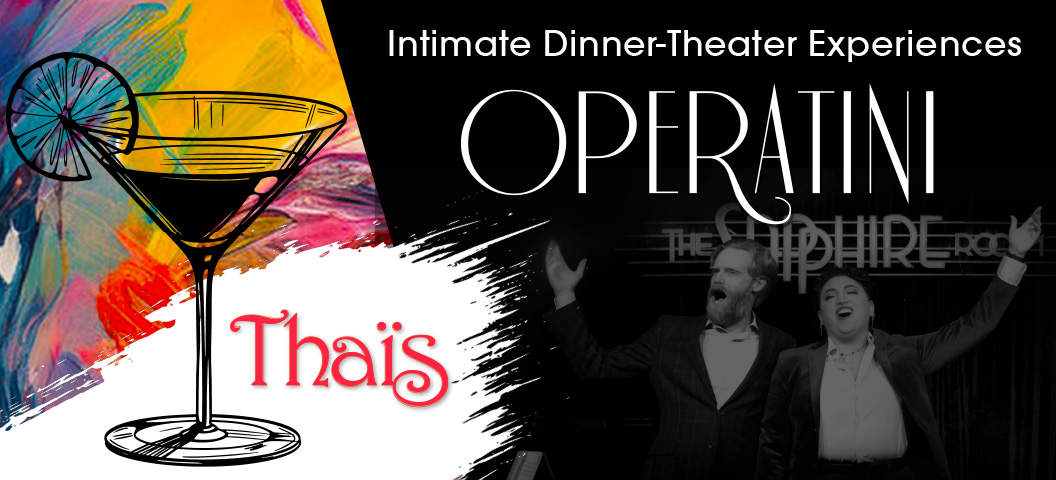
OPERATINI
Thursday, March 19 • 5:00 or 8:00 pm
The Sapphire Room
Tickets $49.64 & $62.36
Spend the evening with the cast of Thaïs as they perform some of their favorite arias and unexpected gems! It’s an intimate and up-close musical experience while you enjoy a cocktail and included Mediterranean buffet.

PRE-PERFORMANCE DINNER
Friday, March 27 · 4:00 pm
The Cellar at Red Feather Lounge
Tickets: $130.00
Indulge in a chef-curated three-course meal with light appetizers and wine pairings, and mingle with fellow opera lovers, board members, and a surprise guest or two. Includes VIP parking for the performance only.

CENTER STAGE WITH STACEY
Friday, March 27 & Sunday, March 29
The Egyptian Theatre
Included with your ticket to Thaïs
Join us one hour before showtime for a special 30-minute pre-performance talk where you’ll explore the music, storylines, and characters to enrich your experience of Thaïs.
Synopsis
ACT I. In the stillness of the desert, Athanaël returns from Alexandria deeply unsettled. The city, he reports, has surrendered itself to pleasure and excess… and at the center of it all is Thaïs, a courtesan whose sensuality and decadence have made her an object of near-religious devotion. Yet his outrage is not purely spiritual. Beneath it lies something more personal: in his youth, he too was entranced by her, a memory he now recasts as sin. He was saved from indulging this sin by lack of means, which he attributes to an act of God.
Determined to reclaim control over the obsession he cannot suppress, Athanaël convinces himself that saving her soul is his divine purpose. Despite warnings from Palémon that such interference defies his vows as a monk, he returns to Alexandria.
There, he seeks out Nicias, a childhood friend who has embraced the world Athanaël rejects. Wealthy, indulgent, and entirely at ease in it, Nicias is amused by Athanaël’s mission and agrees to introduce him to Thaïs… who, at least for one more day, is his lover. At a lavish gathering, their worlds collide. Athanaël demands that Thaïs renounce her way of life and faith; she meets him with wit, confident cynicism, and a sharp understanding of the contradictions he refuses to see. When she publicly humiliates him in a ritual honoring Venus, the encounter only deepens his resolve. What he calls salvation begins to look increasingly like conquest.
ACT II. Alone at last, Thaïs finds that the things she valued are no longer fulfilling her. Surrounded by luxury and adulation, she is increasingly aware of its impermanence. She searches for reassurance in her own beauty, and from the goddess she has served. But doubt has taken root and is festering.
When Athanaël appears, uninvited, she responds as she always has… through seduction, through control. Unlike every other man she has encountered, he is unmoved. Instead, he offers a different vision of love, one that promises “eternal life”… if she will only abandon everything she knows. His words unsettle her not because they are gentle, but because they strike directly into the center of the vulnerability she has just expressed.
Caught between the life she knows and the possibility of something greater beyond it, she vacillates. The familiar voice of Nicias outside reminds her of the world she would leave behind, but when she sends Athanaël to dismiss him, she is left alone with her uncertainty… and her fear.
When she emerges, her decision is made. She will follow him.
Athanaël’s triumph is immediate, but his path to salvation allows no compromise. He insists she destroy everything that has defined her. As a festive crowd gathers to celebrate her once more, they instead witness her renunciation. Her home is set ablaze, her past consumed in fire. The city resists, unwilling to lose its idol, but even Nicias, recognizing the finality of her choice, helps her escape. Together, Thaïs and Athanaël leave Alexandria far behind and go out into the desert.
ACT III. The journey is harsh, and Thaïs, unaccustomed to physical hardship, falters. Athanaël drives her forward with relentless severity, telling her that hardship is necessary for redemption. Only when confronted with the physical reality of her suffering does he allow himself a moment of compassion. Still, trusting him, she follows.
At the convent of Mother Albine, Thaïs is welcomed into a life of quiet devotion. As she follows the nuns into her new life, Athanaël is left behind, and for the first time, he is forced to confront her absence. His spiritual victory begins to unravel into personal tragedy.
Back among the monks, Athanaël cannot return to the certainty he once possessed. Nothing can quiet the image of Thaïs, which now consumes him entirely. No longer able to be lenient with Athanaël for violating the doctrine of their abbey for his obsession, Palemon finally abandons him.
When Athanaël hears the news that Thaïs is dying, he rushes back to her… not to save her, but to reclaim her.
He arrives too late.
In the convent, Thaïs takes her last breaths, transformed in the eyes of those around her into something saintly. As she reaches toward a vision of heaven that Athanaël had taught her, he finally accepts the truth he has resisted. The human, physical love he sought to suppress has overtaken him completely. As she ascends into the eternity Athanaël has promised her, he is left behind.
Season Supporters